
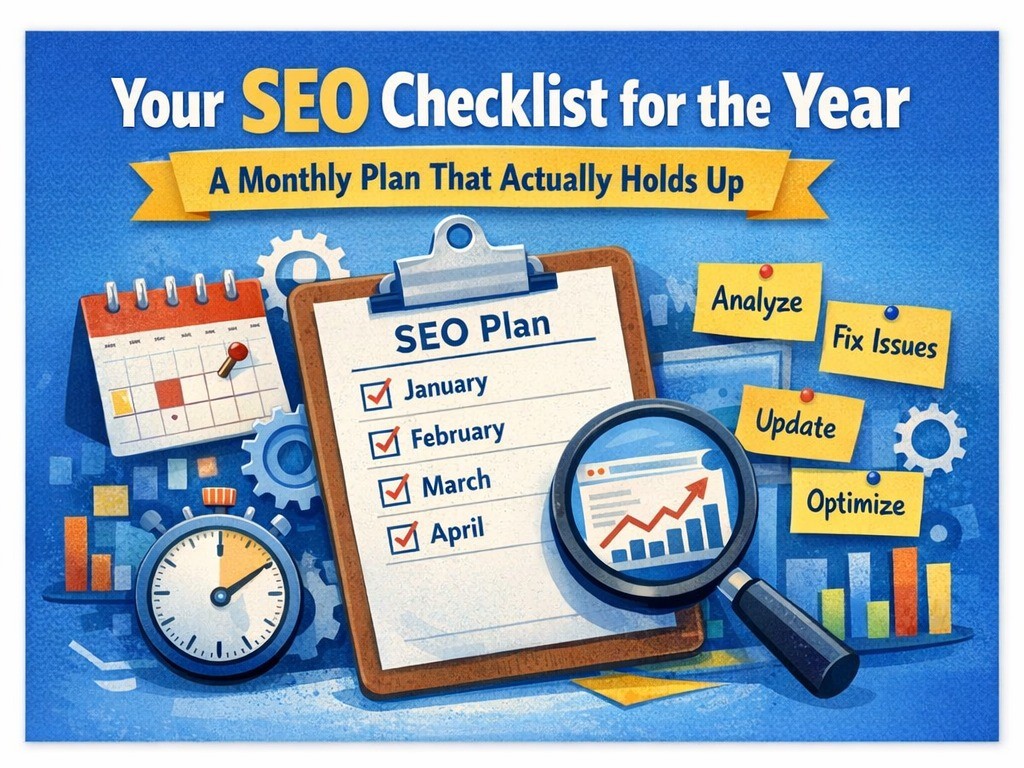
A Monthly Plan That Actually Holds Up
SEO doesn’t fail because people don’t know what to do. It fails because everything gets treated as urgent, permanent, and equally important.
Algorithms don’t work that way. Neither do humans.
The most reliable SEO strategies I’ve seen weren’t aggressive or clever. They were boring in the best possible sense—steady, intentional, and paced. Think maintenance, not sprints.
This isn’t a checklist you knock out in a weekend. It’s a cadence. One that fits into real work, real teams, and real attention spans.
January: Get Your Bearings (Before You Touch Anything)
Resist the urge to “optimize” immediately.
Start by understanding what’s actually happening:
- Which pages consistently attract traffic?
- Where do people drop off without interacting?
- What ranks well but converts poorly?
This is about context, not fixes. If you don’t know what’s working by accident, you won’t know what to protect on purpose.
February: Technical Hygiene, Quietly
No big redesigns. No migrations.
Just basics:
- Crawl errors
- Indexing issues
- Broken internal links
- Page speed outliers (not perfection, just problems)
Technical SEO is like plumbing. When it works, nobody notices. When it doesn’t, everything smells wrong.
March: Revisit Search Intent (Not Keywords)
Look at your top pages and ask an uncomfortable question:
Is this actually answering what the user is trying to do?
Not what you want to say. Not what you rank for. What they came for.
Small rewrites here—headlines, intros, structure—often outperform brand-new content created from scratch.
April: Internal Linking With Purpose
Most sites underuse their own authority.
This month is about connecting dots:
- Older pages pointing to newer ones
- High-traffic content supporting high-value pages
- Removing orphaned content that no longer earns its place
No tools needed beyond common sense and restraint.
May: Content That Deepens, Not Expands
Stop publishing more. Start publishing better.
Choose one or two topics you already rank for and deepen them:
- Add missing context
- Answer follow-up questions
- Improve clarity
Google rewards usefulness over novelty more than people like to admit.
June: UX Signals and Engagement Reality
SEO doesn’t live in isolation anymore.
Check:
- Time on page
- Scroll depth
- Mobile usability
- Intrusive elements that interrupt reading
If users behave like they’re uncomfortable, search engines notice. They don’t need to be told.
July: Prune Without Mercy
Not all content deserves to survive.
This is the month to:
- Consolidate overlapping articles
- Remove outdated or misleading pages
- Redirect what still has value
A smaller site with clearer intent often outperforms a bloated one with “coverage.”
August: Structured Data and SERP PresenceAugust: Structured Data and SERP Presence
This is where subtle advantages live.
Enhance how your site appears:
- FAQs
- How-tos
- Rich snippets where appropriate
You’re not just ranking anymore. You’re competing for attention inside the results.
September: Refresh What Already Ranks
Pages sitting in positions 5-15 are low-hanging fruit.
Minor updates—new examples, clearer formatting, current references—can move them without much effort. This is one of the highest ROI SEO activities, and it’s strangely ignored.
October: Voice and Conversational Search
Search queries now sound like people talking. Because they are.
Review your content:
- Does it answer questions naturally?
- Would it sound normal if read aloud?
- Is it structured for quick, spoken answers?
This isn’t about trends. It’s about how interfaces are changing.
November: Authority Signals
Now look outward:
- Mentions
- Backlinks
- Citations
- Partnerships
Not mass outreach. Not spam. Just credible connections that make sense in context.
Authority grows slowly. Panic-building links never works long-term.
December: Review, Then Leave It Alone
Step back.
- What improved?
- What stalled?
- What quietly performed better than expected?
Document it. Then stop tweaking.
SEO needs rest periods. Constant interference is how good pages get broken.

The Real Takeaway
SEO success rarely comes from clever hacks or heroic effort.
It comes from showing up consistently, knowing when not to act, and treating your site like a living system—not a campaign.
One focused improvement per month beats twelve frantic overhauls every time.
Need help?