Your website may still be online. Your contact form may still work. And technically, nothing may be “broken.” So why would you redesign it? Because a website can keep functioning while quietly becoming less effective, a website can look perfectly fine from the business owner’s perspective while quietly losing customers because it’s slow, difficult to use, outdated, or unclear. That’s where working with a website redesign company can make sense—not because your site needs to look newer, but because it needs to work better for the people using it.
Visitors may be leaving because the site feels outdated, takes too long to load, is difficult to use on a phone, or simply doesn’t make it clear what they should do next. That’s the part business owners don’t always see. You’re familiar with your website. Your customers aren’t. If your website is making people work too hard to understand your business or contact you, it may be time to take a closer look.
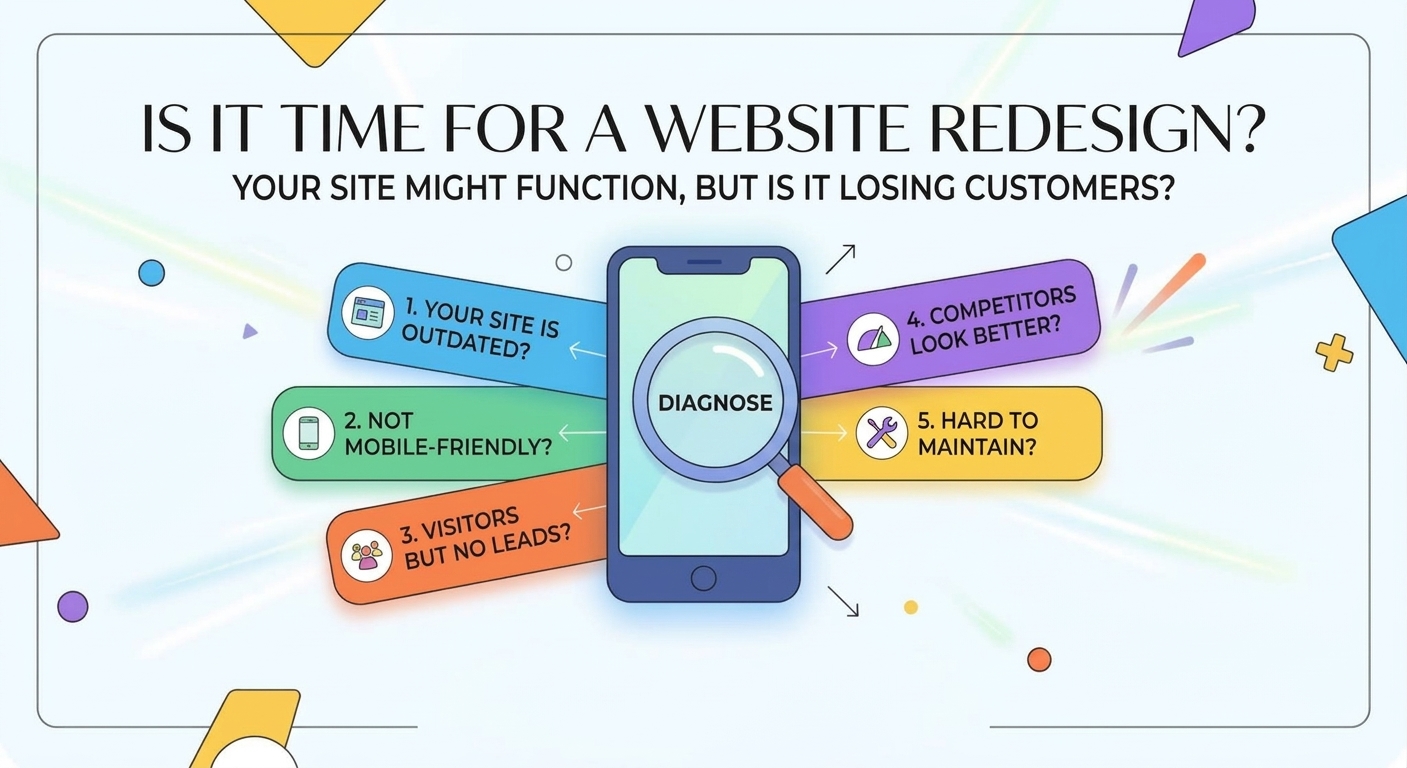
Your Website No Longer Reflects Your Business
Businesses change. Services change, customers change, and sometimes the business itself looks completely different from when the website was first built. But the website often gets left behind.
Maybe you’ve added new services that are buried on an old services page. Maybe your company has grown, but the site still makes you look like a much smaller operation. Or perhaps the messaging was written years ago and no longer explains what makes your business different.
A redesign gives you a chance to bring the website back in line with the business you’re running today. The goal isn’t to make the site look newer just for the sake of looking newer. The goal is to make sure the website accurately represents who you are and what you offer.
Mobile Visitors Are Having a Hard Time
You probably don’t need us to tell you that people use their phones to search for businesses. What matters is what happens when they arrive at your website.
If visitors have to pinch and zoom, scroll sideways, hunt for your phone number, or struggle to complete a form, you’re making it harder for them to become customers. And mobile usability isn’t just about making everything fit on a smaller screen. The navigation, content, buttons, forms, and calls to action all need to work naturally on mobile.
If your website looks fine on your office computer but feels frustrating on a phone, that’s a problem worth fixing.
You're Getting Visitors, But They Aren't Becoming Leads
This is usually the point where a website redesign becomes more than a design discussion. You might already be getting traffic from Google, referrals, social media, or paid advertising. But if visitors aren’t calling, submitting forms, requesting quotes, or taking the next step, something isn’t connecting.
Sometimes the issue is simple. Your phone number is difficult to find. Your contact form is too long. Your service pages don’t answer basic questions. Or your homepage doesn’t explain what you actually do quickly enough.
A good website should guide people. Visitors shouldn’t have to figure out where to go next. Clear messaging, useful content, strategic calls to action, and a straightforward user experience can make a significant difference.
This is also where conversion optimization becomes important. Before rebuilding everything, it can be worth looking at where visitors are dropping off and what may be preventing them from taking action.
Your Competitors Are Offering a Better Experience
You don’t need to copy your competitors. But you should know what potential customers see when they compare you with them.
Imagine someone finds three businesses through Google. One has a dated website with confusing navigation. Another has a clean site that quickly explains its services, shows reviews, answers common questions, and makes it easy to request a quote. The customer doesn’t need to be a web designer to notice the difference.
Your website is part of how people judge your business. If competitors are providing a significantly better online experience, your website could be costing you opportunities before you ever get the chance to speak with a potential customer.
A good website redesign company should look beyond visual trends and consider what your competitors are doing, what your customers expect, and where your current website is falling short.
Your Website Has Become Difficult to Maintain
Sometimes the warning signs aren’t visible to your customers yet. They’re visible to the people managing the website. If every small update requires technical help, plugins regularly cause problems, pages are difficult to edit, or your website platform is outdated, maintaining the site can become more work than it should be.
That matters because an outdated website can eventually affect more than your internal workflow. Old software, unnecessary plugins, poor site structure, and neglected updates can create performance and security issues.
A redesign can be an opportunity to clean up the underlying problems instead of continuing to patch the same issues.
A Redesign Should Be About More Than Making the Site Look Better
This is probably the biggest thing to keep in mind. A new color scheme and attractive homepage won’t automatically bring in more customers. Before starting a redesign, you should understand what isn’t working on the current website.
- Are people finding the information they need?
- Are your most important services easy to find?
- Does the site work properly on mobile?
- Are visitors reaching your contact page?
- Are your calls to action clear?
- Is the site fast enough?
- Are your pages helping your SEO efforts?
These questions matter more than whether a particular design style is currently popular. A website audit can be a useful starting point because it helps identify technical, SEO, usability, and conversion issues before decisions are made about the redesign.
So, Does Your Website Actually Need a Redesign?
Not every older website needs to be completely rebuilt. Sometimes a few strategic changes can solve the biggest problems. Other times, the issues are connected throughout the site, and starting with a new structure makes more sense.
The important thing is to diagnose the problem before deciding on the solution. If your website no longer represents your business, frustrates mobile visitors, fails to turn traffic into leads, falls behind your competitors, or has become difficult to maintain, it’s probably worth reviewing.
How EduCyber Approaches Website Redesign
At EduCyber, we don’t start a redesign by asking what colors you want or which template you like. We start by looking at what the website needs to accomplish. That means considering your customers, services, current website performance, navigation, messaging, mobile experience, calls to action, and overall marketing goals.
The result should be more than a better-looking website. It should be a website that makes it easier for people to understand your business, trust you, and take the next step. Your website should support the rest of your marketing—not work against it. That’s why website design, SEO, conversion optimization, and digital marketing need to work together.
Final Thoughts
A website doesn’t become ineffective on a specific date. It usually happens gradually. One day the design feels a little dated. Then a few pages become difficult to update. Your competitors improve their sites. Mobile users start having problems. And eventually, you realize the website isn’t doing the job you need it to do.
That’s when it’s worth taking a serious look. You may not need to rebuild everything. But if your website is making it harder for customers to find you, understand you, or contact you, waiting probably isn’t helping.